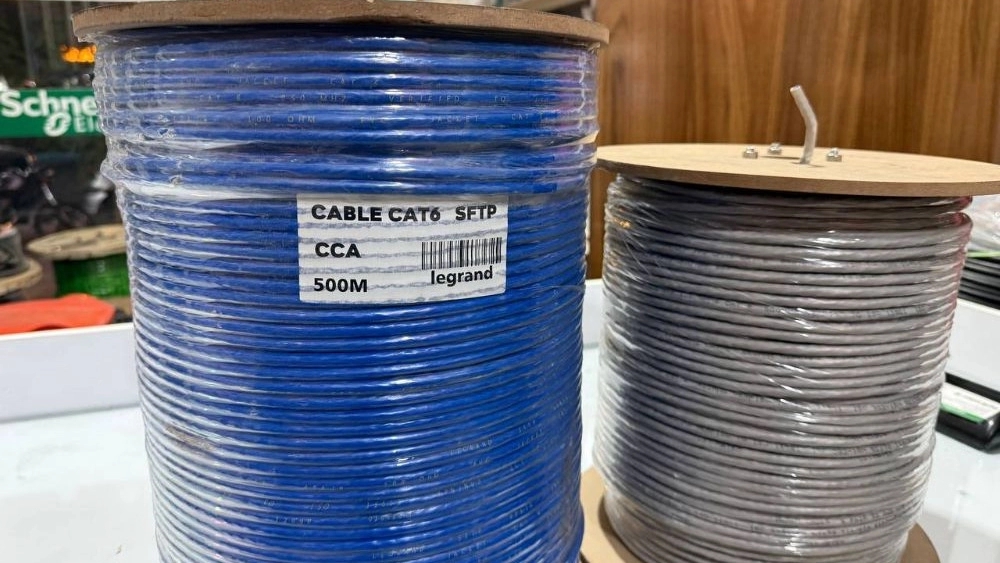
The network cable plays the main role in communicating between network equipment such as switches, modems, routers and computers. Choosing the right type of network cable is very important in industrial and construction network projects, because the quality of data transmission, speed and stability of communication is completely dependent on the type and structure of the network cable.
In this article, from a specialized and practical point of view, we examine the differences and features of CT5 UTP network cable and CAT6 SFTP network cable. This content has been prepared based on technical standards and market needs and has been fully optimized to introduce products on the website of Pishru Sanat Yazd, the industrial electrical equipment exchange in Yazd.
What is CT5 UTP network cable?
Introducing the CT5 or CAT5 cable
CT5 network cable (or CAT5 according to the standard) is one of the most widely used types of network cables in offices, buildings and general applications. This cable is suitable for transferring data at speeds up to 100 Mbps (Mbps) in 10/100Base-T networks.
CT5 UTP network cable structure
Important structural features:
- With 8 strands (4 pairs) of copper
- Without shield and foil
- Conductor diameter usually 0.5 mm
- PVC or LSZH coating (choosable for fireproof environments)
- Maximum allowed length up to 100 meters
Advantages of CT5 UTP network cable
- Economical price: It is cheaper than other models.
- Easy installation: It has high flexibility and light weight.
- Compatibility with common networks: It is suitable for home, office and educational networks.
- Can be used for data transmission, telephone, and low quality IP cameras.
What is a CAT6 SFTP network cable?
Introduction of CAT6 cable
The CAT6 network cable is the more advanced version of CAT5e and is designed to transmit information at a speed of 1 Gbit/s to 10 Gbit/s. This cable is used in high-speed networks, servers, monitoring equipment and industrial systems.
CAT6 SFTP cable structure
SFTP stands for Shielded Foiled Twisted Pair. This cable is structurally more resistant than CAT5 UTP.
Main components:
- 4 twisted and sheathed wire pairs
- Each pair has separate foil (FTP)
- Overall shield for whole cable protection (STP)
- PVC or LSZH outer sheath
- Conductor thickness usually 0.57 to 0.58mm
- Transmission standard up to 250MHz frequency
Advantages of CAT6 SFTP network cable
- Extraordinary resistance to noise: Presence of shield and foil prevents frequency interference.
- Very high speed: Full support from 1000 to 10000Mbps.
- Signal stability over long distances: Data transmission without quality loss up to 100 meters.
- Suitable for industrial environments: It has excellent performance in factories, power stations and noisy environments.
- High useful life: Heat and bending resistant structure.
Application of any type of cable
Where is CT5 UTP cable used?
- Home and office networks
- Telephone systems and VoIP network
- Normal closed circuit cameras
- Automated teller machine (ATM) communication
Where is CAT6 SFTP cable used?
- Industrial networks and noisy environments
- High-speed data transfer between racks and switches
- High-resolution professional IP cameras
- Schneider, Siemens, Delta equipment and smart controllers
Correct selection of cables in industrial projects
In industrial environments such as Yazd factories, the presence of electric motors, inverters and electrical panels causes intense electromagnetic noise. In such a situation, the use of CAT6 SFTP cable is recommended by industrial electrical experts.
On the other hand, if the project includes an internal building network or a simple office system, buying CT5 UTP cable is a cost-effective and acceptable choice.
Network cable installation and maintenance tips
- The cable must pass in a path free of electrical noise (away from the power cable).
- In shielded cables such as SFTP, the earth connection must be done so that the protection effect works properly.
- Avoid excessive bending of the cable.
- The maximum length of the cable is up to 100 meters; In higher lengths, switch or repeater should be used.
Network cable and industrial electrical supplies exchange in Yazd
Pishro Sanat Yazd store, as one of the most reliable distributors of industrial electrical equipment and a Schneider dealer in Yazd, offers a variety of network cables from reputable domestic and foreign brands. By directly supplying CAT5, CAT6 and CAT7 cables from reputable companies, this collection is ready to supply construction, industrial and telecommunication projects across the country.
Features of Yazd industry leading services:
- Expert advice on choosing the right network cable for the project
- Supply of shielded and unshielded cables with warranty
- Fast delivery to the whole country
- Competitive price for electrical and network contractors
Summary
CT5 UTP network cable and CAT6 SFTP network cable are both the most widely used types of cables in the network industry. The main difference between them is speed, noise resistance and protective structure. For home and office networks, the CT5 UTP model is the economical and practical choice, but for industrial and high-speed networks, CAT6 SFTP cable provides stable and secure performance.